Anyone who’s ever been to hear a paper or a talk given has seen the person who takes the mic with the pretense of asking a question, but who instead goes on at length about their own interests, or research, or supposed insights. This type of groan-inducing off-topic interruption may be bearable (may be!) in an academic conference, but where there’s real work to be done, it’s an unforgivable waste of time.
Inarguably provocative title of course, but that's the Red Clarion for you. I find a lot of their writing to come off as somewhat juvenile, even though I have (and will continue to!) praise many pieces that they've published, such as this and this and this. They embody a definite communist angle that I can quite respect, overall.
This is a good example -- yes, as mentioned, provocative title, but the overall point is much more moderate I think. The problems with the stack are embedded in its horizontalism, and horizontalism is something I am more and more finding a thorn in the side of any activist or organizational space (honestly, doesn't even have to be activist! this is as much true in corporate meetings as it is in radical spaces). I fundamentally agree with the concerns expressed in this piece: Complete horizontal free speech opens the door to actual harm as much as it opens the door to, frankly, just obstructionist behavior.
I am more and more finding myself aligned with models that allow for targeted suppression of behavior that does not align with the group's stated aims. The key is, of course, having a robust debate about the group's stated aims and a regular series of check-ins about the current status of the group's stated aims. One might call it a sort of democratic centralism, perhaps.



Many Marxists now agree that the revolutionary left’s protracted crisis is rooted in its failure to escape the “sect” form. As Hal Draper has explained, revolutionary sects are defined less by size than by their mode of organisation: a top-down culture, a haughty and exclusivist attitude towards others on the left, and a puritanical fixation on a “perfect” programme enforced by an intransigent leadership. Such groups prioritise their own growth over the needs of the wider movement and, because their unity rests on rigid doctrinal agreement, have a tendency to repeatedly split over relatively minor theoretical differences. This sect form has become the norm among Marxist organisations, leaving revolutionaries scattered across many small, largely irrelevant groups.

Ali Kadri is an esteemed Professor at various institutions around the world, as well as the author of many important books including Arab Development Denied: Dynamics of Accumulation by Wars of Encroachment, The Accumulation of Waste: A Political Economy of Systemic Destruction, and The Unmaking of Arab Socialism.
Okay, I'll admit that I haven't finished listening to this episode yet. But what I've heard so far is excellent. A great breakdown of the role of the CPC in constraining and managing capital excesses from the Mao to Deng era and beyond.
With reactionary forces bearing down upon us, we, the children of these struggles, must take on this banner and win the war once and for all. To do so, we must develop the means to secure our survival outside of the support from the state or any liberal institution. We must develop cadres that can bring the masses into our joint struggle for liberation, underground communication networks through digital encryption and physical dropbox networks, resource depots (which will form the backbone of a logistical network) to secure the supply of necessities to the people and our revolutionary fighters, basic physical and medical educational programs so cadre are fit to engage struggle they are met with, and we must develop cells within every pore of this country from which we can mount our organized counter-attack. [...] Most of the work of a revolutionary army is logistics, followed by aiding in the work of the people by acting as a pool of concentrated labor, then engaging in direct confrontation with the enemies of the people. The People’s Liberation Army undoubtedly harvested more pounds of rice and millet than can be counted in spent bullet casings. A Communist party is nothing more than the rationalized organization of the people’s collective will, for every gain of the people is a gain for the party, for every loss of the people is a loss for the party.
I always find it enlightening that Mao's theories around guerrilla warfare mesh so well with those of Lawrence of Arabia's, as I think there's a lot to learn from both sources. Putting the organization of trans & queer liberation into these lenses aligns a lot with my feelings.
In Commemoration of the Twenty-eighth Anniversary of the Communist Party of China
classic piece, also notable in comparison to the piece right before this -- i feel like you can see the presaging of modern China in a bunch of this.
State and Capital I: Understanding How the Chinese Communist Party Has Redefined the Function, Boundaries, and Political Position of Capital
fantastic piece on the role of capital in China.
Extracted from an essay published in April 1917 (in Hsin ching-nein). Mao Zedong.
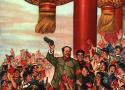
A spectre is haunting China—Mao Zedong. This is not the ossified image of the national founder found in official party histories, but a living, breathing idea rediscovered by the country’s youth. The evidence for this resurgence is both unexpected and unmistakable, and its most dramatic stage is China’s elite universities, where the country’s political, academic, and business leadership is cultivated.
Why hasn’t the so-called u.s. left, despite all of the efforts made over the last two years, been able to meaningfully intervene in a live-streamed genocide?

Joseph Stalin was a great man; few other men of the 20th century approach his stature. He was simple, calm and courageous. He seldom lost his poise; pondered his problems slowly, made his decisions clearly and firmly; never yielded to ostentation nor coyly refrained from holding…
All revolutionary and anti-imperialist organizations must struggle between one another for unity on this line, and where such organizations do not yet exist, they must be built.

I have seen this argument for at least half a decade now, its probably existed past that, but I want to add my bit to it, because, well, fuck this “bigtent” bullshit Idea. I have worked very hard and studied intensely for a very long time now and I refuse

The committee's own data shows that DSA's growth derives not from its sect-like internal processes but from its moments of class-like political action. The organization grows when it acts as a political force in the world, and withers when it retreats into self-administration.
I consider myself electorally-critical at best and thus I would argue with many of the points brought forth in this story, but I do think there's value in it overall. The nature of the DSA is that it tends to spike in population when it has something to rally around, and it withers when it does not. In this, at least, myself and the author are aligned. You must be a shark, always moving, never staying still. Grow the tendency, guide the tendency, shape it into a party, take control.

A major theme in Bolshevik literature was the transmutation of flesh to metal. In the communist imagination, the fires of revolution could forge a metallized man. No one better personified this than Stalin, the “man of steel.” In my latest article, I explore the power of a name.
The CPUSA, FRSO, PSL, and DSA are not identical, but all suffer from a palpable stagnancy.
The Party will form the vanguard of the revolution only when the masses of the most oppressed internationally recognize it as their representative and their weapon in the class struggle, wielded by and in the interests of the international proletariat.
The following article is the result of a visit to the People’s Republic of China to participate in celebrating China’s 80th Anniversary of its victory over Japanese fascism. Dee Knight and DSA China Working Group coordinator Anlin Wang were part of a five-person self-organized delegation of DSA members.

The first version of this article was written after the first three months of being back in China after too long away. The version written then contained many immediate impressions and experiences, which I interpreted on the basis of extensive earlier research. There is an…
There is a fundamental contradiction in many of the Marxist studies that are produced in the West. Every time that they speak of Marxism in Asia — in China, Korea or Vietnam — or when they speak of popular movements in Africa such as in Egypt or Libya, they highlight the…
[T]he working class cannot simply lay hold of the ready-made state machinery, and wield it for its own purposes.
- Marx