Behind the curtain of war propaganda, the Ukrainian working class is suffocating under the weight of increasing state violence and corruption.
Getting reasonable analysis of the war in Ukraine is a total pain in the ass in the United States, at least. I appreciate this piece for being a straightforward and well-argued analysis of the class aspects of the war.
The modern Russian federation is no worker's state. Modern Ukraine is neither. I don't see a way to interpret this war as a fight that Leftists (& especially Marxists) need to 'support' on either side. However, also and importantly, this is not a case of entirely imperialist adventure -- the government of modern Ukraine is explicitly right-wing and interested in maintaining a relationship with the imperial core. The government of modern Russia is explicitly right-wing but not interested in maintaining a relationship with the imperial core (favoring the modern coalition of BRICS, which has fair things to critique but is definitively not part of the global imperialist core).
This robbery of the working class in Ukraine is of course no new phenomenon. Just as in Russia, since the reintroduction of capitalism, “big business [has] turned the state into an institutional tool for realising the interests of oligarchic groups. There [has] emerged a peculiar phenomenon of ‘state capture’”. However, the development of full scale war has led to a shift in the nature of capture, away from local oligarchs and instead in favour of internationalised (western) capital.
It is nearly impossible to overstate how much the current political terrain of the former Soviet nations was explicitly the goal of the American-led crusade to destroy the USSR. This war would not be happening if the USSR was still around. That is not a paean toward a past that we lost as much as a statement of reasonable fact! When I see the peoples of 'Ukraine' and 'Russia' fighting each other, it is heartbreaking precisely because we have living memory of a time when these lines of identification did not bring about warfare. It was in the time of the USSR.
Although many opposition parties have experienced wartime repression in Ukraine, anti-communist and anti-socialist repression has been widespread since 2015, when a number of authoritarian laws were passed following the victory of the far right during the Euromaidan.
I do not care for the modern Russian federation, the same as I do not care for the government of the United States. It is a tragedy what happened, and it is a tragedy that continues to unfold. But to support the Ukrainian state uncritically is also deeply fraught, and I would argue not any more defensible as an ideological position.
New laws banned the Communist Party and its publications, along with any communist symbols. Singing the Internationale, the international song of worker’s solidarity, was made punishable by up to five years in prison. The use of the state to persecute the left followed severe and bloody street violence perpetrated by fascist paramilitary groups in Ukraine during the Euromaidan. Just a year before the ban on communist party activities, on the 2nd of May 2014, around a thousand fascist thugs under the banner of Right Sector (a Neo-Nazi paramilitary group) surrounded the House of Trade Unions in Odessa, setting fire to the premises where dozens of terrified workers had sought sanctuary. Right Sector members, barricaded exits and beat the men, women and children who threw themselves out of the windows of the building trying to escape. A total of 48 people were burnt alive that day, in what Right Sector proudly described as “yet another bright page in our fatherland’s history.”


But the reality of a leaderless and structureless movement started by 50 people is, who decides who’s in and who’s out? When millions are now joining you, how do you centralize messaging? How do you stay on target for what you are organizing? In a running theme of this era, the political explosion that MPL created against not a fascist military dictatorship, but a progressive, left-leaning democratic administration, gave open ground for the far-right to take control.
I think that it would be understandable for people to take issue with my growing feelings around needing strong, verticalized, centralist structures to build movements on, but it comes from the same feelings that motivate this piece. Horizontalism is a deeply frustrating way to organize an entire movement, or even worse an organization. Best case scenario is things are slow. Worst case scenario, you are destroyed by the same fascist forces you are hoping to defeat.
It is obvious we have seen consecutive ‘biggest protests in human history’ to little global systemic change. Spontaneous uprisings have been a feature of the 21st century. In some places, one political elite was simply replaced with another. In other places, the states and capitalists cracked down on the movement so hard it hasn’t recovered. Other places were broken by the political vacuums created with no real, organized working class movement to fill that gap.
Imagine for a minute, the ICE uprisings keep scaling upwards. Millions and millions are shutting down the country. Rolling General Strikes from state to state. Then mass marches on the capital, and Trump’s goons flee to Epstein’s Island or some other far hideaway. Who, or what groups, will take over the political power of the country? How will the next decision get made? Did classes disappear? Did the social ills created by US settler colonial society disappear?
This is the key question and my greatest frustration with the modern American left. I am tired of "street protests". I am tired of "calls to action". Not because these things are bad, or even unnecessary, but because in order to work they have to be backed up by concrete organization, something that I feel we are terribly lacking.
So when looking at the vast field of lost revolutions of the 21st century, and the gravestones of all the martyrs we lost along the way, we have to ask ourselves, did we organize correctly? And the answer from the available evidence in most cases says we didn’t. Now we are facing an even worse ecological crisis, rising fascism, a new state of imperialist world order, and mass fascist violence in the streets of the capitalist hegemon—the U.S.. What changes have been made? Are we organizing differently from 2011? Because if we wish to succeed, we must.
This is what makes the Russia case still valuable for a global left: the trace of the desire for collective social reproduction is still damp, still excavatable. It has not yet fossilized.
No one is ever fully lost to the cause, if you can figure out how to leverage them.
What is now visible in the provincial factories and metalworking plants of post-2022 Russia is, I argue, an attempt to reconstruct something functionally analogous — not by the state but by individual firms, not through the mechanisms of Soviet paternalism but through an uneasy combination of Soviet idiom and neoliberal discipline. [...]
This sceptical realism is, in E. P. Thompson’s terms, a form of moral economy: an operative understanding of what is fair and what is not, what obligations employers owe to workers, what the minimum terms of dignified employment consist in. It draws on the Soviet legacy not as nostalgia but as a set of standards — imperfectly realized, often betrayed, but remembered — against which present conditions are assessed and found wanting. The vernacular socialism that others have traced in Russian working-class culture is not gone; it is simply subterranean, surfacing in the calibrations of people like Misha rather than in explicit political contestation.
emphasis mine.
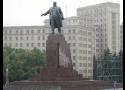
Our relationship to the Soviet Union is simple. The USSR was the first country to build socialism, and we believe that we should analyze the Soviet experience in order to prevent the restoration of capitalism in the future, as it happened in the Soviet Union. Therefore, there is no reason to idealize or, on the contrary, try to abandon the Soviet legacy, as many “leftists” like to do. This is a wrong approach and has no practical utility.
Really deeply well-told interview with members of the Worker's Front of Ukraine, an explicitly Marxist-Leninist organization within Ukraine that is working against the current war. I very much appreciated the RFU representatives clear-eyed analysis of the current war as an imperialist conflict between NATO and the (imperialist, post-Soviet) Russian State.
I cannot imagine how hard and brave it is to be an avowed Marxist-Leninist in Ukraine these days. It's scary enough in the United States, but we are not quite yet at the stage where the state is killing you in the streets for it. The notes about international solidarity with underground and aboveground groups in Russia was also fascinating -- I think this is a great blueprint for how to organize in imperialist nations. Build the party, educate the people, refuse to participate in nationalist-chauvinist activity.
In fact, fascism is an open terrorist dictatorship of the most reactionary, most chauvinistic, and most imperialist elements of financial capital. Different fascists may think differently about women, gender, and LGBTQ+, but that doesn’t change the essence of fascism. As for us, we consider all those issues as parts of the issue of the proletariat. No more no less. You cannot free women without freeing the working class. Period.
The Ukrainian delegations in the early Soviet union were some of its most ardent supporters. I wish one day that we will see that again.
Therefore, to truly defeat imperialism, we must carry out a socialist revolution and defend our military-industrial complex, which has been destroyed by the capitalist regime in 30 years of “independence.” Precisely when private ownership of the means of production is abolished and the dictatorship of the proletariat is established, only then will we be able to truly defeat imperialism, both Russian and Western.