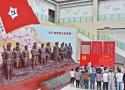
Self-reform is how the CPC answers the oldest question in Chinese statecraft: how to escape the historical cycle of rise and decline. Its answer is to never stop struggling, and never let up on its fighting spirit in order to improve and to better represent the interests of the people.
Funny that I ran into this right after posting (positively!) about this piece on Ukraine from Fight For A Future, which is a publication that I do not agree with about their views on China (though I will admit they are not the rabid anti-China sort like many other worse members of the commentariat).
Carlos Martinez is one of my favorite writers on modern China not just because he is a fanboy (which I think is completely fair given the state of modern China compared to most of the US-aligned global West) but because he is a skilled writer and arguer about the ways that the CPC is specifically utilizing Marxist-Leninist thinking in their operations. Not shying away from fair criticisms, but taking the stance that adaptation is crucial to any ongoing communist project.
Where I think the PRC, and the CPC specifically, excels is the understanding that progress will take a long time, and thus it is imperative that a socialist project survive, even if that means taking some Ls along the way (and for what it's worth, I think the PRC has made a lot of mistakes, both historically and contemporarily! I just also think those mistakes do not change the progressive direction of CPC leadership). Or, to quote Martinez:
Ultimately, however, the test on these new battlefields is the same test the CPC has passed before, in a new form: Whether it can keep identifying the principal contradiction of the period and mobilizing society to resolve it, without either capitulating to external pressure or abandoning the peaceful, people-centered and win-win character that has defined Chinese modernization. On the record of the last 105 years, I would not bet against the CPC and the Chinese people surmounting these new challenges.


The plain fact is that the climate crisis cannot be addressed within capitalism. This may be difficult for some to come to terms with, but it is vital that we understand this fact and develop our strategies accordingly, otherwise we are headed for certain failure. And on this issue, failure is not an option.
Jason Hickel, as usual, right on the money.
Whether a state is socialist should be judged by real-world outcomes rather than rigid ideological purity.
I wrote about it a bit on the Big Blog already, but Deng Xiaoping and the 1980s China period (that was the immediate precursor to China's current era of Xi Jinping leadership) was a huge influence on THE REVISIONIST. I like this post.

Ali Kadri is an esteemed Professor at various institutions around the world, as well as the author of many important books including Arab Development Denied: Dynamics of Accumulation by Wars of Encroachment, The Accumulation of Waste: A Political Economy of Systemic Destruction, and The Unmaking of Arab Socialism.
Okay, I'll admit that I haven't finished listening to this episode yet. But what I've heard so far is excellent. A great breakdown of the role of the CPC in constraining and managing capital excesses from the Mao to Deng era and beyond.

Educational and inspirational resources to help us imagine the end of capitalism instead of the end of the world.
This looks like a great set of resources/links for folks interested in communist, socialist, or anarchist education.