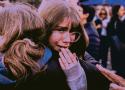
It is undeniable that Jewish history hurts, that it leaves lasting wounds on its victims that reverberate through the generations, turning the family into a site of remembrance for a tragic history that is deeply felt, yet can never be truly known. But history is ultimately a narrative form, and its utility lies in how that narrative is constructed. In other words, what we are calling trauma is more likely a collective story with a discrete political function. To place our faith for defeating Zionism in the demand to heal is to treat politics as a pathology, and obscure politics as the method we must use to fight.
The creeping nature of "trauma" as a complete explainer for most/all modern problems is something that I simultaneously feel is adequate and wholly inadequate. On the one hand, yes, trauma is real and can affect (in many cases severely affect) one's way of living in the world. On the other hand, to use 'trauma' as a single, be-all-end-all explanation for worldly concerns is to misunderstand its nature.
This is a piece about Jewishness, which I don't have any familial history of to my knowledge. But similar frameworks around "ancestral trauma" are common in Black circles, and this is something that I have to be very delicate about: yes, of course, trauma due to racism exists. But I quibble a bit at the idea of "ancestral trauma" as something immaterial, something "intrinsic to the soul/body" or something like that. There is systemic injustice, which can certainly shape a culture, and thus the culture can shape the self, but I think that is often misdiagnosed as "ancestral trauma", if that makes sense.
Rubin even goes so far as to argue that Jews constitute a “collective body”—a “whole and unified organism” or “soma” that can act in concert in the way that redwood trees “shape their bodies to support and heal together” when one tree experiences an injury.
Yeah, like that sort of thing, exactly. That is a fiction. It is a narrative. There is use in that narrative, but it is not true (I am nearly echoing word-for-word one of the things that I praise Umineko for teaching me, so this is, I guess, also an advertisement for Umineko (??))
The reality is that humans are not redwood trees, and—as the historian Saul Friedländer observed in a 2013 lecture about the enduring prominence of the Holocaust in Israeli national consciousness—trauma changes form when it moves from the individual to the collective. While individual trauma typically takes root in the family or a similarly “closed emotional field,” Friedländer noted, collective trauma comes about through the communal process of giving meaning to such an event, turning an “incomprehensible occurrence” into a coherent narrative. This resulting story serves a “social function,” providing an “empowering mandate for the community.” Jewish collective trauma, of course, has been transformed into a mandate for Zionism’s crimes, and progressive Jewish trauma discourse is at its most cogent when it acknowledges this as a social and political process.
Also, as always, free Palestine.
It is trauma, [Firestone] argues, that “often complicates Israel’s military policies in the West Bank,” leading to disproportionate responses among soldiers facing down children with rocks. By this logic, Israeli violence toward Palestinians is not the outcome of brutal state policies, but an organic expression of collective Jewish suffering that disrupts an otherwise “healthy” instinct for self-defense. Politics, here, is fully subsumed by the psychological. Healing opens a path to redemption for the perpetrators, while relegating the victims’ claims back to the margins.

