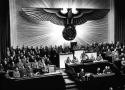
It seems counterintuitive that Hitler could emerge in a country that led the world in science, architecture, and industrial design, where every town had orchestras playing Beethoven. Germany in the 1920s was one of those places and times in history where you had this critical mass of geniuses. And yet it went down the drain and was replaced by Hitler’s unspeakably barbaric regime.
Standard disclaimer here that Hett is very much a classic American liberal democrat and thus espouses plenty of that ideology in his responses here, but even so it is very funny to see Hett rebutting the interviewer who keeps trying to say "but isn't this just like Trump?" with "No, it's actually pretty different."
I think it's easy to look at Our Current American Moment and try to map it to, say, 1930s Germany but it's actually something quite a bit mutated from that. Relatable, yes, but not 1:1.
[Hitler's] supporters had a tendency toward political nationalism and were happy to be in a situation where they could break some left-wing skulls. The party may have been centered in lower-middle-class tradesmen, but some prominent, wealthy businesspeople around Munich were also attracted to him. It wasn’t until later that the Nazis’ following crystallized around the rural, Protestant middle classes and, to some extent, the upper-middle class.
This is, imo, the most comparable aspect of early Nazism to our current moment -- the linking-together of the rural regressive elements with the moneyed capitalist interests, which exist in the upper-middle to upper class strata of American society. This is very Nazi-esque, without a doubt.
I have to admit, I occasionally have the highly undemocratic thought that, though it’s great in theory for everybody to have a voice, not all voices are equal in merit.
Maybe so, Hett! Maybe so! Maybe that's not that ridiculous of an idea when some voices are actually quite harmful. Maybe those voices should face some sort of consequences, lmao.
Hitler was also pretty hardheaded about certain realities, such as the fact that to conquer parts of Eastern Europe, he needed modern industry — a military-industrial complex, as President Eisenhower would later put it.
Again, I think often people liken the Current American Moment to Nazis due to the traditionalist aspects, but that is, I think, not quite correct -- the Nazis were futurists, in a sense. Early fascism was very technologically focused, in the same way as many ideologies in the early 20th century were. It wasn't until after WW2 that you really saw the upswing in "back to the land" conservatism, partially in response to the horrors of WW2. An understandable trauma response in a sense, but not particularly progressive.


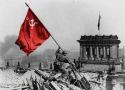
The Soviet Union carried the overwhelming weight of the war against fascism.The Eastern Front dwarfed the Western one in every measure that mattered. The Red Army faced and destroyed roughly 80% of the Wehrmacht's combat power. The Soviet people lost over 27 million lives — military and civilian alike. That is more than 60 times the combined military deaths of the United States and Britain. The Red Army stopped the Nazis at Moscow and Stalingrad, broke their back at Kursk, liberated Auschwitz, and planted the Victory Banner over the Reichstag in Berlin.Without the Eastern Front, there would have been no D-Day. Without the Soviet sacrifice, there would have been no victory in the West at all.

Many Marxists now agree that the revolutionary left’s protracted crisis is rooted in its failure to escape the “sect” form. As Hal Draper has explained, revolutionary sects are defined less by size than by their mode of organisation: a top-down culture, a haughty and exclusivist attitude towards others on the left, and a puritanical fixation on a “perfect” programme enforced by an intransigent leadership. Such groups prioritise their own growth over the needs of the wider movement and, because their unity rests on rigid doctrinal agreement, have a tendency to repeatedly split over relatively minor theoretical differences. This sect form has become the norm among Marxist organisations, leaving revolutionaries scattered across many small, largely irrelevant groups.
H-PRC is the H-Net presence of the PRC History Group, a network of scholars with interests in the history of the People’s Republic of China. We define history broadly, to encompass a wide variety of disciplinary approaches, and we understand the history of the PRC to include eras prior to the official change of state power in 1949.

Many old house owners have been left guessing “How old is my house.” This post will give you the tools to answer that question.
My dad was a housemover -- the kind that moves physical houses, not the stuff inside houses. It's a weird, very bespoke job that is mostly done by specialized contractors working with high-value buildings that need to be physically moved usually at the whims of a collector or rich guy. My dad helped move at least one Frank Lloyd Wright house in the 90s, strapped it to a couple of trucks and slowly walked it down the highway to a new location. There's some photos of it online if you look it up, I think.
But anyway, growing up around that has meant that I have always had a fascination with houses and housing. It's one of the aspects of life that is easy to overlook given the fact that buildings, broadly speaking, are everywhere. But every building has a history! If you can look deeply at these little bits of history, you can find out some really amazing things.
George Psalmanazar (c. 1679 – 3 May 1763) was a Frenchman who claimed to be the first native of Formosa (today Taiwan) to visit Europe. For some years, he convinced many in Britain, but he was eventually revealed to be of European origin.
Historical crazy white boy. What a wild con.
In Commemoration of the Twenty-eighth Anniversary of the Communist Party of China
classic piece, also notable in comparison to the piece right before this -- i feel like you can see the presaging of modern China in a bunch of this.
Extracted from an essay published in April 1917 (in Hsin ching-nein). Mao Zedong.

Joseph Stalin was a great man; few other men of the 20th century approach his stature. He was simple, calm and courageous. He seldom lost his poise; pondered his problems slowly, made his decisions clearly and firmly; never yielded to ostentation nor coyly refrained from holding…

A major theme in Bolshevik literature was the transmutation of flesh to metal. In the communist imagination, the fires of revolution could forge a metallized man. No one better personified this than Stalin, the “man of steel.” In my latest article, I explore the power of a name.

It is an interesting and somewhat macabre parlor game to play at a large gathering of one’s acquaintances: to speculate who in a showdown would go Nazi. By now, I think I know. I have gone through the experience many times—in Germany, in Austria, and in France. I have come to know the types: the born Nazis, the Nazis whom democracy itself has created, the certain-to-be fellow-travelers. And I also know those who never, under any conceivable circumstances, would become Nazis.
The way Iran has been able to stand up to the West has become a source of admiration across the formerly colonized world. Where does that confidence come from?
Jake Paul’s ascent in boxing is a cultural symptom of an empire in decline. It reflects a country that now prefers empty spectacle over real strength, both in sports and on the world stage.
Abolitionists waged war on the two party oligarchy. Jenna Grove suggests we can learn from their forgotten triumph.
Most of what we hear about Tiananmen in 1989 focuses on student activists, since they dominated Tiananmen square itself and waved banners demanding “freedom and democracy.” However, the real history of the protests is a bit more complex.
Three years ago I came across an interesting paper written up by a Microsoft employee, Kent Sullivan, on the process and findings of designing the new user interface for Windows 95. The web page has since been taken down - one reason why I'm a bit of a digital hoarder. It specified some of the…
Originally anonymously published on Zuoyi23’s WeChat and Zhihu pages, this essay explores the rise and fall of the capitalist class in China. The author takes a critical look at how the relationship between the state and capital continues to shape the relationship between the capitalist and working classes in China—and how young workers are returning to Marxist critique to shape the future.
Appreciated this nuanced take from Qiao Collective on the current(-ish) situation with tech labor in China.