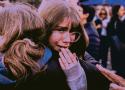
It is undeniable that Jewish history hurts, that it leaves lasting wounds on its victims that reverberate through the generations, turning the family into a site of remembrance for a tragic history that is deeply felt, yet can never be truly known. But history is ultimately a narrative form, and its utility lies in how that narrative is constructed. In other words, what we are calling trauma is more likely a collective story with a discrete political function. To place our faith for defeating Zionism in the demand to heal is to treat politics as a pathology, and obscure politics as the method we must use to fight.
The creeping nature of "trauma" as a complete explainer for most/all modern problems is something that I simultaneously feel is adequate and wholly inadequate. On the one hand, yes, trauma is real and can affect (in many cases severely affect) one's way of living in the world. On the other hand, to use 'trauma' as a single, be-all-end-all explanation for worldly concerns is to misunderstand its nature.
This is a piece about Jewishness, which I don't have any familial history of to my knowledge. But similar frameworks around "ancestral trauma" are common in Black circles, and this is something that I have to be very delicate about: yes, of course, trauma due to racism exists. But I quibble a bit at the idea of "ancestral trauma" as something immaterial, something "intrinsic to the soul/body" or something like that. There is systemic injustice, which can certainly shape a culture, and thus the culture can shape the self, but I think that is often misdiagnosed as "ancestral trauma", if that makes sense.
Rubin even goes so far as to argue that Jews constitute a “collective body”—a “whole and unified organism” or “soma” that can act in concert in the way that redwood trees “shape their bodies to support and heal together” when one tree experiences an injury.
Yeah, like that sort of thing, exactly. That is a fiction. It is a narrative. There is use in that narrative, but it is not true (I am nearly echoing word-for-word one of the things that I praise Umineko for teaching me, so this is, I guess, also an advertisement for Umineko (??))
The reality is that humans are not redwood trees, and—as the historian Saul Friedländer observed in a 2013 lecture about the enduring prominence of the Holocaust in Israeli national consciousness—trauma changes form when it moves from the individual to the collective. While individual trauma typically takes root in the family or a similarly “closed emotional field,” Friedländer noted, collective trauma comes about through the communal process of giving meaning to such an event, turning an “incomprehensible occurrence” into a coherent narrative. This resulting story serves a “social function,” providing an “empowering mandate for the community.” Jewish collective trauma, of course, has been transformed into a mandate for Zionism’s crimes, and progressive Jewish trauma discourse is at its most cogent when it acknowledges this as a social and political process.
Also, as always, free Palestine.
It is trauma, [Firestone] argues, that “often complicates Israel’s military policies in the West Bank,” leading to disproportionate responses among soldiers facing down children with rocks. By this logic, Israeli violence toward Palestinians is not the outcome of brutal state policies, but an organic expression of collective Jewish suffering that disrupts an otherwise “healthy” instinct for self-defense. Politics, here, is fully subsumed by the psychological. Healing opens a path to redemption for the perpetrators, while relegating the victims’ claims back to the margins.


It seems as though only when we list out all that is happening around us, can we, for a moment, summon the vertiginous feelings of overwhelm and dread we seemingly do everything in our power to suppress. Three years of a genocide transpiring in plain sight — one by which we increasingly scroll with the flick of a thumb; a new, stupid and brutal war whose consequences include an impending economic and energy crisis unlike anything the world has ever seen before; the accelerating destruction of the planet; the dismantling or elimination of the institutions that protect and enrich us; the wanton targeting of things that many of us love — the earth, the birds, learning, reading, the arts, one another; an emerging global consensus in which children are increasingly viewed as disposable, the terrifying erosion of the rights of women, trans people, immigrants, the mentally ill, the poor, and the persecution of those on the Left — I can name more, but there is no point, save for perpetuating this mounting discomfort. To consider even a single one of these elements in its entirety is already too much for the ordinary mind to to bear, and yet we are asked to bear all of them simultaneously every single day.
Impossible to talk enough about the memorable quotes in this piece. Kate Wagner once again knocks it out of the park with this, combining the psychological with the social (the psychosocial, some might say) into a rumination, a paean about grief and perserverance.
I don't know where "we" go from here, but I also can recognize that "we" are situated in a moment that I would call 'imperial collapse' (as Kate also aptly puts it), and that things feel incredibly disoriented. Systems that once worked no longer work, horrors beyond measure are commonplace, even intrusive, even in the lives of those who do not directly see them.
I have become transfixed, these days, on trying to figure out how we got this way. I'm not a scholar, I'm not an academic, I'm just kind of an armchair history dork who is finally getting to the modern era, the 19th century and onward, and realizing that all that shit that Lenin was talking about re: the systems of capitalism building up and up and up and creating their own gravediggers might have something to it. There's a lot that I think you can point to the end of WW2 and say "ah, here is where things started getting really bad" and that might be true, but you could also point to a million other times. As Kate points out in the footnotes, the American Reconstruction era is another good touchpoint.
Because we members of Western society are not socially permitted to express despair in everyday life, we are more often than not forced into a kind of cruel and unsustainable quiescence. We learn as children that the suppression of our emotions is integral to social equilibrium within the family, something which is then extrapolated onto public life at the high, high cost of the subconscious belief that our emotional needs do not ultimately matter beyond ourselves. The despair of others frightens us in part because it forces us to reckon with that same bargain. What makes you so special? What gives you the right to cry?
My therapist would chastise me (politely) for agreeing with these feelings, and she would be correct to do so. I grew up a man, I grew up in America. These two things have instilled in me a pathological distaste for expressing tender emotion. It's not a good thing.
The breakdown of the society in which we were born and raised has, in fact, already happened. It has happened and continues to happen by way of several concurrent historical processes from which one can cherrypick their best narratives about how precisely it all came to pass.